Where to buy a home in the Mediterranean without overtourism

To buy a home in the Mediterranean without overtourism, look for three things at once: a destination with moderate tourism in absolute terms, land protected by law from further building, and a specific location away from where hotels, cruise passengers and nightlife concentrate. In the Balearics, Menorca's north coast is one of the few places that meets all three, with its own airport and services all year.
"Overtourism" is often used loosely. It is more useful to translate it into indicators you can check before signing, because a house is bought for twenty years, and what surrounds it matters as much as the house itself.
How do you measure overtourism in a place?
With five indicators any buyer can look up:
- Absolute visitor numbers. How many people arrive per year and in high season.
- Peak population on the ground. In the Balearics, the statistics office Ibestat publishes it monthly as a "human pressure indicator".
- Concentration. Whether the pressure is spread out or packed into a few centres.
- Land protection. Whether planning allows or prevents more building on the coast.
- Mass-arrival infrastructure. Cruise terminals, large airports, ferry ports with daily surges.
No destination scores perfectly on all five. What matters is the comparison.
What do the data say for the Balearics and the Riviera?
In volume, the differences are huge. Between January and July 2025, 7,884,814 tourists arrived in Mallorca, 2,106,645 in Ibiza and Formentera and 993,640 in Menorca (Ibestat). The Côte d'Azur, covering the Alpes-Maritimes and Monaco, exceeded 12 million tourists in 2025.
At peak, on the busiest day of May 2025 there were 1,360,551 people on Mallorca, 276,185 on Ibiza and 161,659 on Menorca. Cruises add to this: a citizens' platform estimated 541 calls in Palma in 2025, with more than 1.8 million passengers who do not appear in tourist statistics.
Relative to residents, however, no island escapes summer: Menorca's socio-environmental observatory (Obsam) estimates 17 tourists per resident a year in Menorca and 21 in Ibiza and Formentera. That is why the fourth and fifth indicators, land protection and concentration, carry so much weight.
Why does land protection matter so much?
Because it decides what a place will be like in twenty years. A spot that is quiet today may not stay quiet if planning allows new developments around it.
Menorca was declared a UNESCO Biosphere Reserve in its entirety on 8 October 1993. Since then it has held back urban growth, keeps long stretches of undeveloped coast and a 185 km public coastal path, the Camí de Cavalls. In addition, Balearic Law 3/2022 suspends new tourist beds on the island until the island council sets a cap based on carrying capacity (we explain it in Holiday rentals in Menorca in 2026).
For an owner, this means new sea-front supply is scarce and the landscape you buy is reasonably safeguarded.
Where do people concentrate within an island?
Almost always in a few places. In Menorca, according to Obsam, Ciutadella holds 46% of tourist beds, and municipalities full of holiday resorts, such as Sant Lluís, reach 33.1 tourists per inhabitant. The north coast, by contrast, has fewer hotel beds and residential settlements.
So the useful question is not just "which island?" but "which street?". A house on a cul-de-sac, in a residential area, facing open sea, experiences summer very differently from one on the front line of a town beach.
Four Mediterranean destinations side by side
| Indicator | Menorca | Mallorca | Ibiza | French Riviera |
|---|---|---|---|---|
| Tourists | 993,640 (Jan–Jul 2025) | 7,884,814 (Jan–Jul 2025) | 2,106,645 incl. Formentera (Jan–Jul 2025) | Over 12 M (2025) |
| Peak population | 161,659 (May 2025) | 1,360,551 (May 2025) | 276,185 (May 2025) | n/a |
| Airport (passengers 2025) | 4.2 M | 33.8 M | 9.1 M | Nice: 15.23 M |
| Land protection | Whole island a Biosphere Reserve (1993) | Serra de Tramuntana | Posidonia and Dalt Vila (UNESCO) | Protected enclaves on an urban coast |
| Brake on new tourist beds | Suspension under Law 3/2022 | Zonal limits | Zonal limits | No equivalent |
When should you NOT choose Menorca to escape overtourism?
Menorca is not empty, and it is worth knowing that:
- In August the island doubles its population. In August 2025 it reached 230,833 people. The best-known coves fill up.
- Water is under pressure. The island's aquifers show over-extraction and saltwater intrusion in some areas, a challenge for any owner with a garden and pool.
- If you want total isolation, there are smaller, more remote islands, at the cost of worse connections and services.
- If you cannot choose your location, the advantage fades: Ciutadella or the south coast in summer are not the north coast.
From the Mediterranean to a single street: Coves Noves
Applying the five indicators, Menorca's north coast comes out well. Coves Noves, in Es Mercadal, is a residential area above Port d'Addaia, next to the Addaia salt flats and close to s'Albufera des Grau Natural Park, about 20 minutes from the airport.
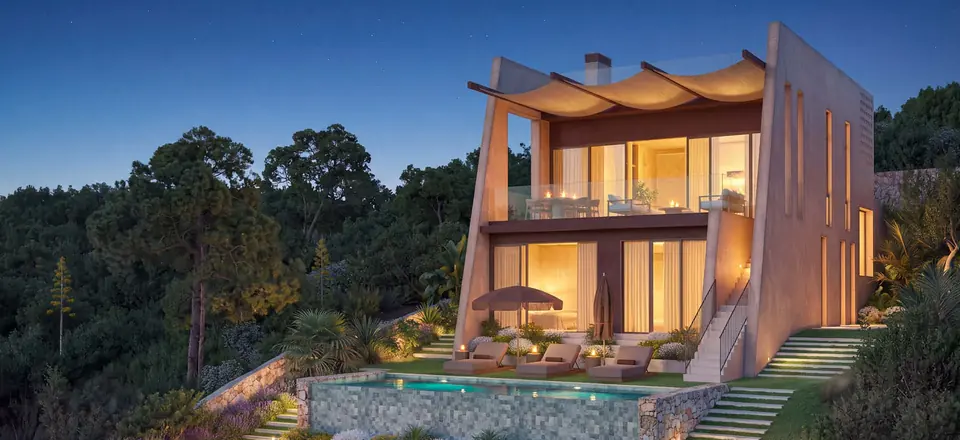
That is where we designed the LLUM villas, on Calle Acacias, a cul-de-sac with no through traffic. The four houses step down the natural slope so that all look out to sea without compromising each other's privacy; you can see what they look out on in Views.
Conclusion
No place in the Mediterranean with good weather and good connections is free of tourism. What does exist are places where volume is moderate, land is protected and pressure concentrates away from where you live. Menorca, and its north coast in particular, combines all three with its own airport and year-round services, which few destinations can claim.
If you would like to check this on the ground, we can arrange a private viewing in Coves Noves or send you the LLUM brochure. Message us on WhatsApp at +34 611 359 567 (ref. VM-CN).
Frequently asked questions
What is the least crowded place in the Balearics?
In absolute terms, Formentera, although relative to its 11,690 residents it fills up the most in summer. Among islands with their own airport, Menorca is the least crowded: it received 993,640 tourists between January and July 2025, against 7.9 million in Mallorca, according to Ibestat.
Is Menorca overcrowded in summer?
There are many more people in summer, as everywhere in the Mediterranean: in August 2025 the island reached 230,833 people, twice its residents. But the pressure concentrates in Ciutadella and on the south coast; the north coast stays far more residential and calm.
What is the human pressure indicator?
It is an Ibestat statistic estimating how many people, residents and visitors, are on each Balearic island every day. It shows the real peak occupancy, which is a more useful guide than annual tourist numbers to how an island feels in high season.
Can new hotels be built in Menorca?
Balearic Law 3/2022 suspends new tourist accommodation in Menorca, including holiday-rental homes, and any increase in beds, until the island council sets a cap based on a carrying-capacity study. It is worth checking whether the suspension is still in force at any given time.
How do you choose a quiet area before buying?
Visit in August and in January, check whether the street carries through traffic, look at the planning status of neighbouring plots and find out where the nearest hotel beds are. In the Balearics, Ibestat's human pressure indicator helps you understand each island's real peak.
This article is for information only and reflects data available on the publication date.
Sources
- Ibestat, tourists January–July 2025 by island, and Palma cruise estimate (Ara Balears)
- Ibestat, human pressure in May 2025 by island (Ara Balears)
- Ibestat, August 2025 human pressure in Menorca (Menorca.info)
- Obsam: tourists per resident and bed concentration (Menorca.info)
- Menorca.info, 2025 economic yearbook: Sant Lluís and the state of the aquifers
- Côte d'Azur France Tourisme: 2025 tourism review
- Aena 2025 passengers: Menorca
- Aena 2025 passengers: Palma
- Aena 2025 passengers: Ibiza
- Nice Côte d'Azur Airport 2025
- Visit Menorca: Menorca Biosphere Reserve
- Balearic Law 3/2022 on sustainable tourism (BOE)